
Intergenerational Report 2026: Implications for aged care advice
The Intergenerational Report 2026: Australia’s Future to 2066 identifies population ageing as one of the five major transitions that will shape Australia over the next 40 years. Ageing will accelerate due to increasing life expectancy and falling fertility rates, driving significant growth in demand for aged care and support services as well as reshaping both the economy and government finances.
Population ageing is not simply a demographic trend. It is a major economic and fiscal transition that will underpin the demand for aged care advice over the next 40 years and elevate the importance of planning for later-life care needs. For financial advisers, this strengthens the case for incorporating aged care discussions into retirement planning well before a care event occurs.
Aged care planning will increasingly become a more common and expected component of retirement advice, rather than a specialist service used only in crisis situations.
Intergenerational wealth issues will also become more important. Aged care decisions often have significant implications for family wealth, housing assets and inheritances. As a result, advisers may increasingly need to help families balance care objectives with broader estate planning and wealth transfer goals.
Ageing will drive greater demand for care
Australia's population has been ageing more quickly than anticipated, with lower fertility rates accelerating this trend.
Australians will have among the longest life expectancies in the world, projected to be 89.5 years for women and 86.1 years for men by 2065–66, arising from ongoing improvements in health care, healthy lifestyles and medical innovation.
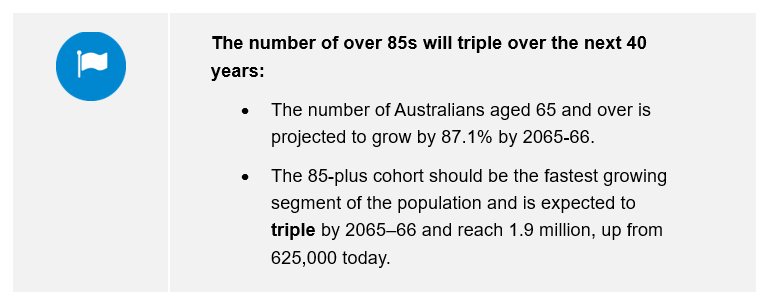
The growth in the population aged 65-plus was illustrated in the Intergenerational Report in the diagram below.
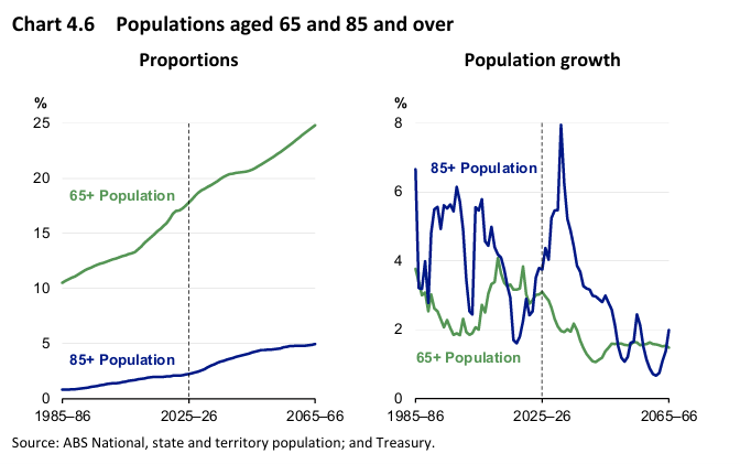
For advisers, this population ageing will be reflected in client bases, with a greater proportion of clients likely to require advice with aged care planning, whether for themselves or for ageing parents.
Care costs are likely to become a larger retirement issue
Australians will continue to live longer, increasing demand for health, aged care and support services and placing growing pressure on government expenditure over coming decades. We have already seen Government looking to shift some of this burden back to older Australians through the 1 November 2025 aged care changes. These changes are also creating a difference in lifestyle quality for clients who can afford to pay additional fees, than for those who cannot.
Retirement planning can therefore no longer focus only on accumulating sufficient assets and generating retirement income. Clients also need to include contingency planning to include potential care costs rather than relying solely on government support.
Advisers should consider:
Future care needs and funding for both support at home and residential care
Housing decisions that may affect care decisions
The financial impact of declining health and independence
The role of family in providing support.
The impact for the carers
The culmination of rising care needs, inadequate supply of workers and care beds and rising costs is likely to increase demand and pressures on unpaid carers.
The ‘sandwich generation’ is likely to be squeezed further. Australians, mostly working women, provided around 12.3 billion hours of unpaid care[1], valued at $461.1 billion in the September 2025 quarter and not all of this was childcare – it also includes care for older adults. As the population ages, demand for care and the pressure on unpaid carers will intensify. This trend negatively impacts the ability of the ‘sandwich generation’ to adequately plan for their own retirement.
Advisers need to consider how this trend may affect clients in the sandwich generation, including the impact of caring responsibilities on their cash flow, superannuation contributions and capacity to plan for their own retirement.
The care economy will become more prominent
The care economy is a major growth area within Australia's service-based economy. As demand for care increases, labour, investment and public spending will continue to shift towards health and care-related services.
Australia’s workforce has been shifting towards service industries, such that the health care and social assistance industry employs around 2.4 million people, which represents about 16% of the workforce.
Employment in the health care and social assistance sectors has grown by 13% since 2023 and is anticipated to grow a further 23% by 2035.
Advice implications
The Intergenerational Report 2026 reinforces that population ageing will make aged care planning an increasingly important part of retirement advice. Longer lives, rising care costs, greater reliance on unpaid carers and pressure on government support mean advisers should raise care needs earlier and incorporate them into retirement income, housing, superannuation, estate planning and family wealth discussions.
This includes working with older clients to include contingency planning to meet their aged care needs, as well as recognising the financial impact on clients in the sandwich generation, whose caring responsibilities may reduce cash flow, superannuation contributions and their capacity to fund their own retirement.
By planning before a care event occurs, advisers can help clients and their families make more informed decisions, preserve choice and build greater financial resilience for later life.
[1] The Intergenerational Report 2026. Data as at September quarter 2025